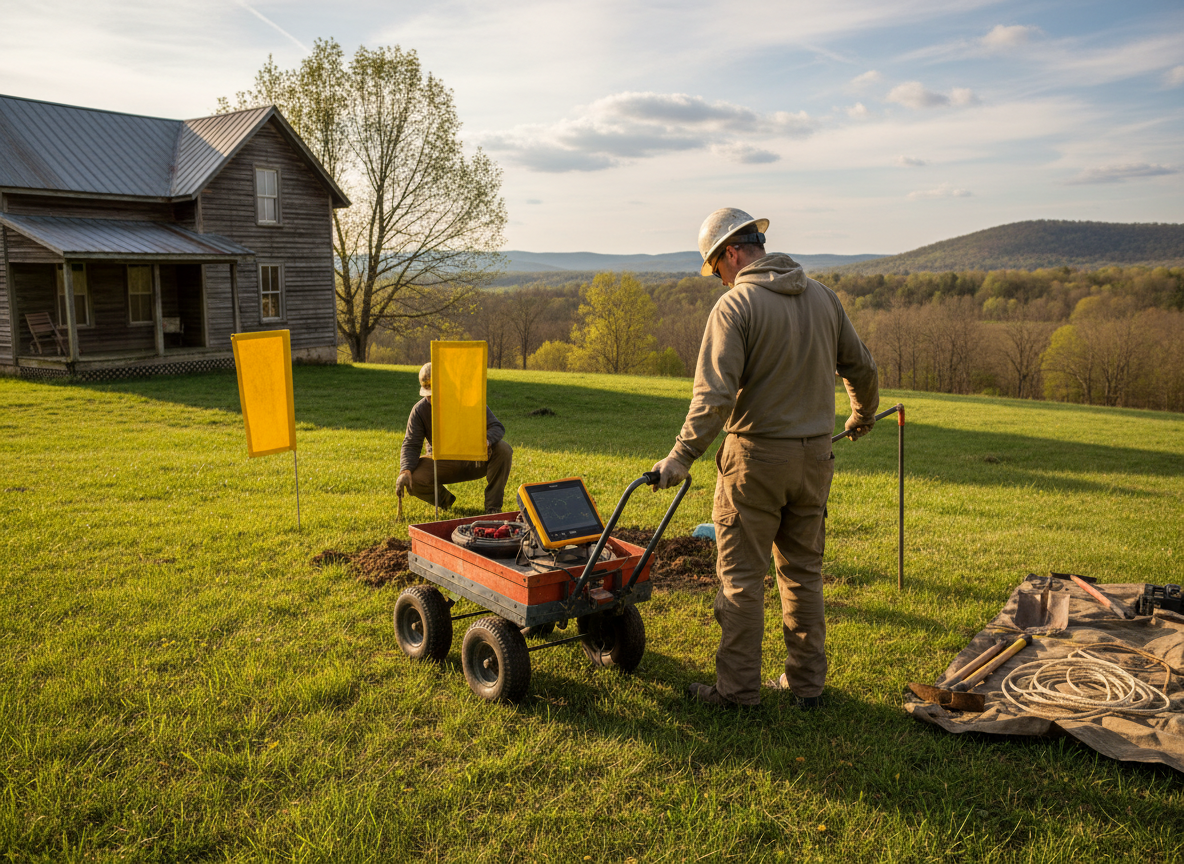
Martinsburg properties along Opequon Creek and Tuscarora Creek often sit on karst limestone with shallow bedrock that forces tanks into irregular placements. We start by walking the lot for clues like slight depressions, vent pipes near the house, or faint paths from the kitchen line. In North Martinsburg and outlying Berkeley County parcels, older farmhouse tanks frequently lie under driveways or near shale ridges, so we mark suspected corners before any digging begins.
Winter calls add another layer when frozen ground hardens the topsoil and hides the usual soft spots. We adjust probe angles around sinkholes common near WV-45 and WV-51, checking for the inlet and outlet tees without disturbing the distribution box. On lots near North Mountain the shallow bedrock can tilt a tank, so we verify depth at multiple points rather than assuming a standard layout found in newer subdivisions off I-81.
Once located we note riser condition, effluent filter status, and any tree-root intrusion that blocks access. Rural Jefferson County parcels with water-softener discharge or garbage-disposal load often show thicker scum layers that affect how quickly we can expose the lid. This step-by-step check prevents unnecessary excavation on saturated drain fields common after wet springs in the Shenandoah Valley.
Technician insight
In Martinsburg the thing that catches most people out with Locating a Septic Tank is shallow bedrock around North Mountain and the karst limestone near WV-9 that tilts older farmhouse tanks at odd angles, so a standard probe pattern from flatter lots often misses the actual lid by several feet.
Hidden Tank Near Driveway Edge
A homeowner in a newer subdivision off I-81 could not find the tank after a backup. We probed along the side yard where shallow bedrock forced the tank closer to the driveway than expected. Once the lid was exposed we cleared roots from the outlet tee and confirmed the drain field was still accepting flow. The tank was pumped and the location mapped for future visits.
Locating a Septic Tank Services We Offer
✓Probe and Locate Service
Systematic ground probing identifies tank corners on lots with shallow bedrock and karst features around Martinsburg.
✓Access Point Excavation
Careful digging exposes lids and risers while avoiding damage to inlet and outlet tees on older buried tanks.
✓Tank Mapping for Records
We document exact tank position, baffles, and distribution box location for future pumping on rural Berkeley County properties.
✓Riser and Lid Verification
Existing risers are checked for proper height and secure lids so winter frozen ground does not complicate later access.
✓Effluent Filter Inspection
Filter condition is assessed during location to prevent clogs from water softener discharge common in the area.
How it works
- 1
Review Lot History
We examine property layout relative to Opequon Creek, roads like US-340, and known older farmhouse placements.
- 2
Surface Walk And Clues
Visual signs such as vent pipes, soft spots, or grade changes are noted before any probing starts.
- 3
Systematic Probing
Rods are driven at measured intervals to locate tank edges while accounting for shallow bedrock and shale ridges.
- 4
Confirm And Mark
Tank corners, baffles, and access points are marked and recorded for the next service visit.
Pricing
Cost depends on tank size, access and condition.