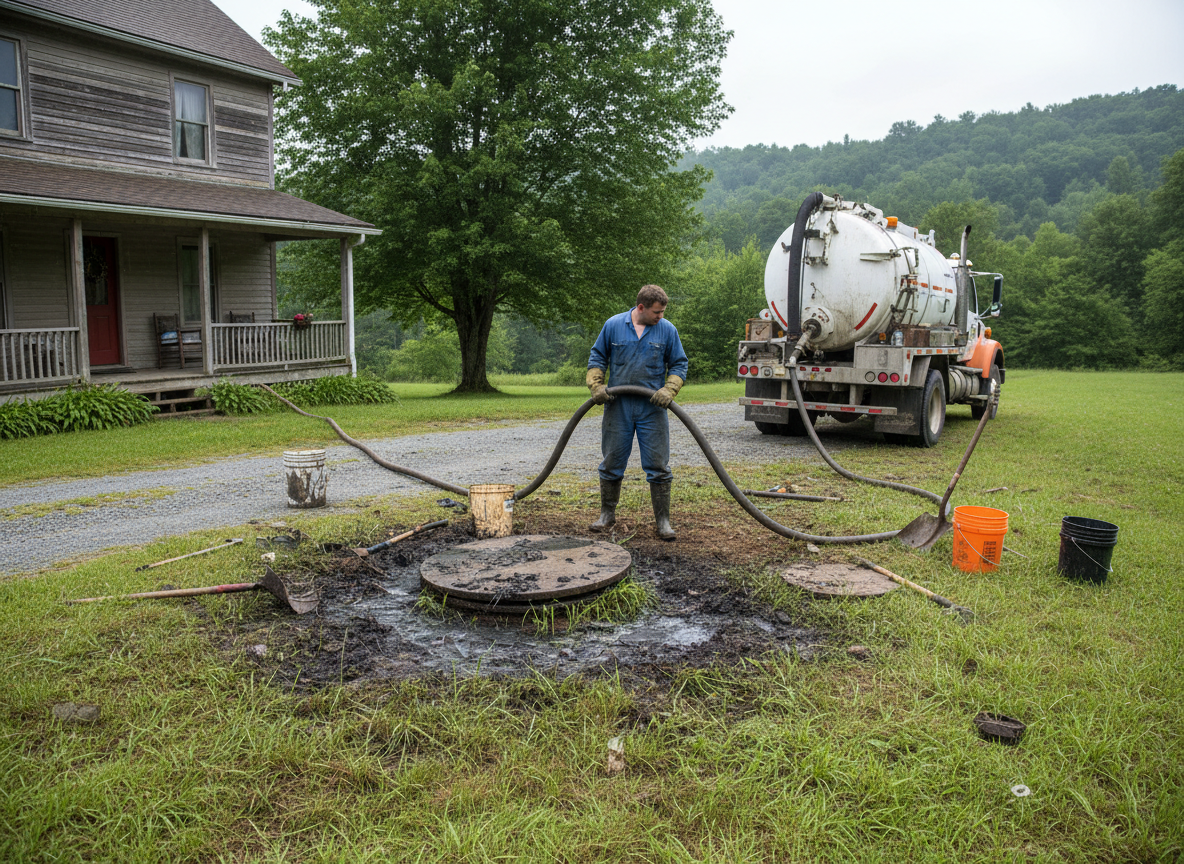
Homeowners in North Martinsburg and along Opequon Creek notice gurgling toilets, sewage odors near the tank, or slow drains when the drain field becomes saturated. Shallow bedrock and sinkholes common in the Shenandoah Valley karst limestone allow water to pool quickly during wet springs, pushing sludge and scum layers back toward the house. We see this frequently on older farmhouse properties where the original tank sits close to shale ridges and tree roots have infiltrated the inlet or outlet lines.
Our first check involves locating the buried tank and distribution box, then measuring sludge and scum depths while inspecting the effluent filter and baffles for damage. On lots near Tuscarora Creek or off WV-45, we also probe the drain field for standing water and test the pump chamber float switch if an aerobic system is present. Frozen ground in winter often masks early warning signs until a sudden thaw or heavy rain overwhelms the system, especially on properties without risers and lids that allow easy access.
Rural homes outside public sewer lines in Berkeley and Jefferson Counties face extra challenges from water softener discharge and garbage disposal loads that accelerate buildup. We trace backups to the source by checking for blockages between the house and tank, then evaluate whether the distribution box is directing effluent evenly. Cold winters with deep frost combined with wet springs mean many systems need attention before the next freeze cycle sets in.
Technician insight
In Martinsburg, the thing that catches most people out with Septic Backup is how shallow bedrock and shale ridges let spring melt and rain push effluent straight back into the house on older farmhouse lots without risers. Homeowners often wait until the ground thaws before calling, but by then the distribution box is already under water and the job takes longer.
North Martinsburg Farmhouse Backup After Thaw
A property off US-11 experienced repeated gurgling and odors following a wet spring. We found the drain field saturated due to karst limestone and shallow bedrock, with roots blocking the outlet tee on an older tank. After pumping and clearing the line, flow returned and the homeowner was advised to monitor during the next freeze cycle.
Septic Backup Services We Offer
✓Drain Field Saturation Assessment
We measure soil moisture and locate pooling areas caused by shallow bedrock and sinkholes typical around North Mountain and I-81 corridors.
✓Baffle and Tee Inspection
Technicians check inlet and outlet tees for breaks that let solids reach the drain field, a frequent issue on older tanks near WV-9.
✓Effluent Filter Cleaning
Clogged filters are removed, cleaned, and reinstalled to restore flow before backups reach the house on rural Berkeley County lots.
✓Pump Chamber Float Switch Service
We test and replace faulty float switches that fail to activate during high-water events common after spring rains on karst terrain.
✓Tree Root Intrusion Removal
Roots entering through risers or cracked lines are cleared to prevent recurring backups on properties near WV-51 and US-340.
How it works
- 1
Site and Tank Access
We locate the tank using property records and probe for lids, clearing access points on lots with heavy vegetation or recent grading.
- 2
Component and Field Evaluation
Sludge levels, baffles, effluent filter, and drain field saturation are checked while noting any signs of water softener or disposal overload.
- 3
Targeted Clearing and Pumping
Blockages are removed and the tank is pumped to relieve pressure, with special care for frozen ground conditions or high water tables.
- 4
Verification and Recommendations
Flow is tested after service and homeowners receive guidance on seasonal factors like wet springs that affect system performance.
Pricing
Cost depends on tank size, access and condition.