On older farmhouses outside Martinsburg city limits and in North Martinsburg subdivisions, tanks often sit under two feet or more of soil because original installers worked around Tuscarora Creek floodplains and shale ridges. We see inlet and outlet tees buried so deep that locating them requires probing through tree roots or water softener discharge lines. Karst limestone pockets and sinkholes force us to map the exact tank location first so we do not hit bedrock or create new drainage issues toward Opequon Creek.
Before any digging we check the condition of baffles, effluent filters and the distribution box by running water from the house and listening for gurgling or sewage odor at the surface. Shallow bedrock along WV-9 and WV-45 often means we cannot excavate straight down, so we use angled approaches that still keep risers plumb. In winter the same lots freeze solid, making it impossible to reach the tank without pre-installed risers that let us work from above the frost line.
Rural lots on US-340 and WV-51 frequently combine newer subdivision tanks with older farmhouse tanks that lack risers entirely. Wet springs saturate drain fields while cold snaps leave frozen ground for weeks, so homeowners cannot schedule routine pumping without major excavation. Adding risers and lids lets us reach the sludge and scum layers quickly and avoids compacting soil over the drain field during every visit.
Technician insight
In Martinsburg, the thing that catches most people out with Septic Riser Installation is shallow bedrock on North Mountain lots that sits only eighteen inches under the topsoil. Older farmhouse tanks were set right against those shale ridges, so we often have to angle the riser or build a small concrete collar instead of digging straight down like we can on deeper Jefferson County clay.
North Martinsburg Farmhouse Tank Access
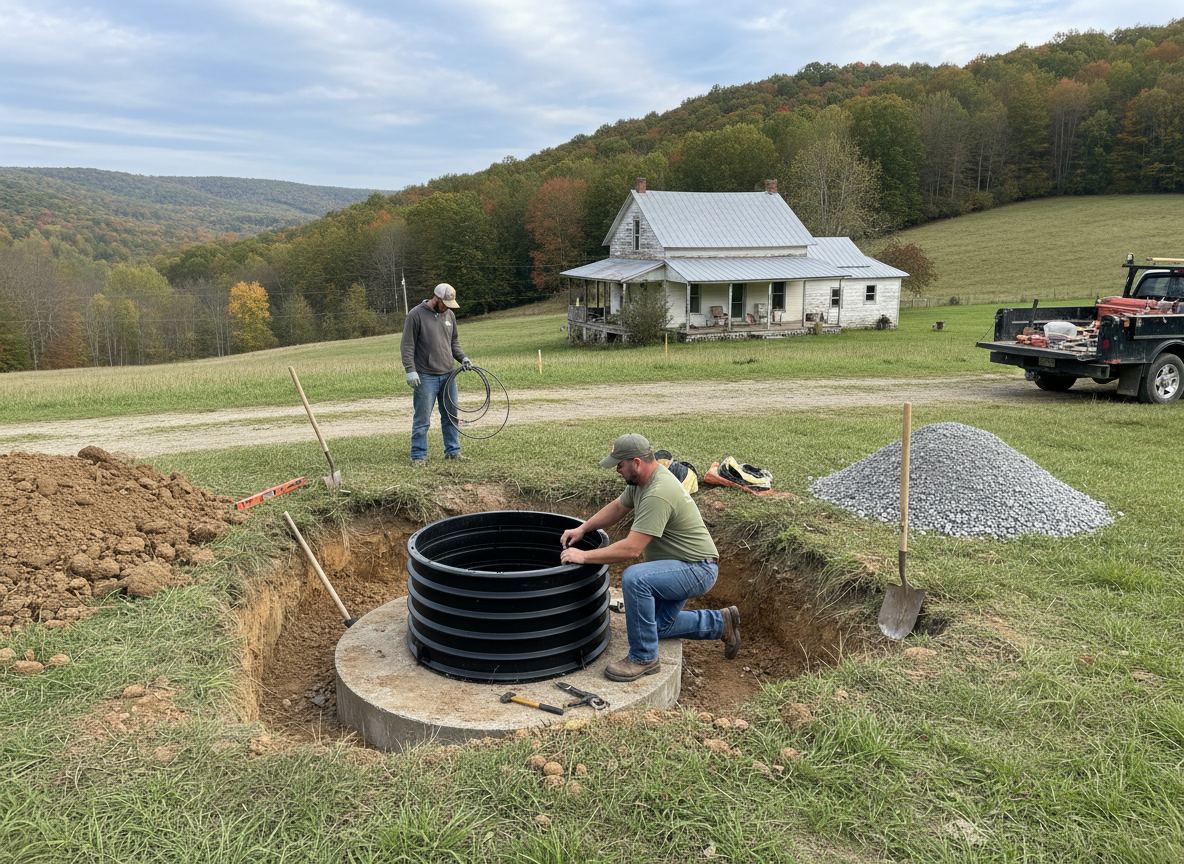
The homeowner could not reach the tank during spring thaws because it sat under two feet of soil on a lot with shallow bedrock near Tuscarora Creek. We located the tank, confirmed the baffles were intact, and installed two 24-inch risers with sealed lids. After backfill the tank could be pumped from the surface even when the ground froze solid the following winter.
Septic Riser Installation Services We Offer
✓Buried Tank Riser Addition
Extends access to tanks set below grade on lots with shallow bedrock so pumping can occur without repeated excavation.
✓Effluent Filter Riser Installation
Brings the effluent filter to the surface for regular cleaning on systems near Opequon Creek where water softener discharge accelerates buildup.
✓Pump Chamber Lid and Riser Retrofit
Replaces or adds risers over pump chambers and float switches so alarms and maintenance stay accessible year-round despite frozen ground.
✓Distribution Box Riser Setup
Installs risers at the distribution box to allow inspection of flow to the drain field on karst limestone lots where settling is common.
✓Aerobic System Riser Upgrade
Adds or extends risers on aerobic tanks common in newer Berkeley County subdivisions so all compartments remain reachable without disturbing landscaping.
How it works
- 1
Locate and Expose Tank
We probe the lot using known landmarks such as the house cleanout and driveway edges, then carefully remove soil while watching for tree roots and shallow bedrock.
- 2
Assess Existing Openings
We inspect baffles, inlet and outlet tees, and any existing lids to determine the correct riser diameter and height needed for the specific tank.
- 3
Attach and Seal Risers
Risers are secured to the tank lid openings with appropriate gaskets, checked for level, and backfilled in layers to prevent shifting on shale or limestone slopes.
- 4
Restore Surface and Test
Soil is replaced and compacted, lids are set flush, and water is run through the system to confirm no leaks or flow restrictions at the new access points.
Pricing
The final cost for septic riser installation depends on tank size, access and condition.